The Dense Advantage: Why Ripple-65B Preview is a Strategic Win for Local Agentic Coding
The open-source AI landscape is often defined by a frantic race toward "bigger is better." As proprietary giants push the boundaries of parameter counts and Mixture-of-Experts (MoE) architectures to achieve superhuman reasoning, the community has often been left chasing the crumbs of distilled, smal
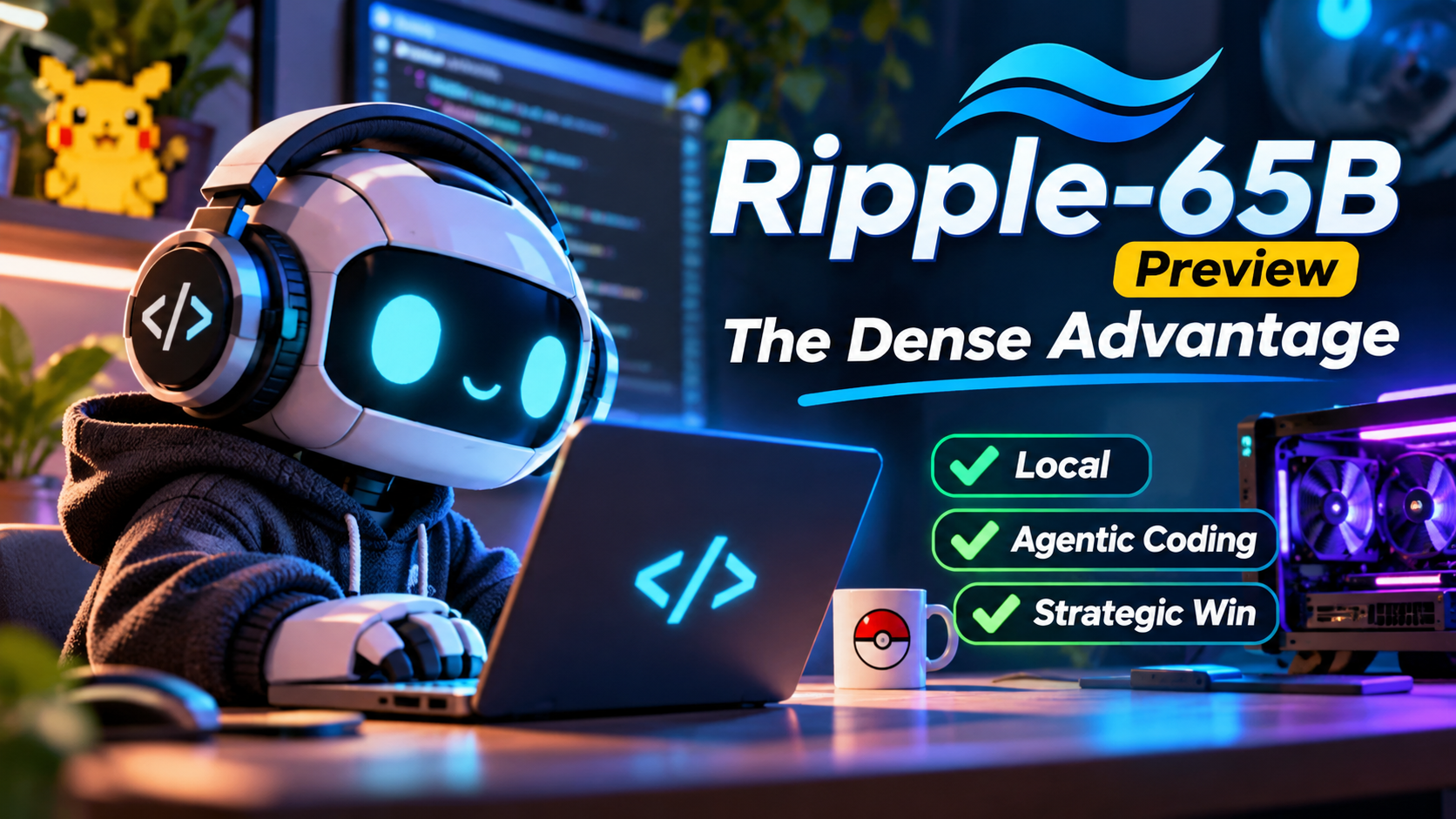
The open-source AI landscape is often defined by a frantic race toward "bigger is better." As proprietary giants push the boundaries of parameter counts and Mixture-of-Experts (MoE) architectures to achieve superhuman reasoning, the community has often been left chasing the crumbs of distilled, smaller models. However, a new contender from the United States is challenging the notion that sheer scale and architectural complexity are the only paths to utility.
Ricursive Intelligence, a US-based firm specializing in AI chip design, has officially released Ripple-65B Preview. Released under the highly permissive Apache 2.0 license, this model isn't just another entry into the crowded LLM marketplace; it is a specialized tool aimed squarely at the burgeoning field of agentic coding. By prioritizing a dense architecture and high-quality pretraining over the "sparse" efficiency of MoE, Ripple-65B offers a unique value proposition for developers who need high-performance autonomy on private, local infrastructure.
Architecture Matters: The Case for Dense Transformers
In recent years, the industry trend has shifted heavily toward Mixture-of-Experts (MoE) architectures. MoE models, like those seen in many top-tier proprietary systems, activate only a fraction of their total parameters for any given token, allowing for massive scale without a proportional increase in compute cost per inference. While efficient for massive-scale cloud deployments, MoE models can be notoriously difficult to optimize for local, predictable hardware environments.
Ripple-65B takes a different path. It is a dense Transformer model with 65 billion parameters. In a dense model, every parameter is utilized during every forward pass. While this requires more raw compute per token compared to an MoE model of similar total size, it offers several distinct advantages for the target user:
- Predictable Compute Profiles: Unlike MoE models, where routing logic can lead to variable latency, dense models provide a consistent computational footprint.
- Hardware Optimization: Ricursive has specifically optimized Ripple-65B for Nvidia hardware, ensuring that the dense matrix multiplications are handled with maximum efficiency on modern CUDA cores.
- Simplified Deployment: For developers running local workstations or private enterprise servers, managing a single dense weight set is often more straightforward than managing the complex routing and memory requirements of a sparse MoE system.
By investing $32 million into R&D and training on a massive 12 trillion token corpus, Ricursive has built a model that trades the "scaling laws" advantage of sparsity for the "reliability" advantage of density.
Benchmarking the Agentic Frontier
The primary mission of Ripple-65B is to excel at "agentic coding"—the ability of an AI to not just suggest snippets of code, but to operate within a terminal, navigate file systems, and execute complex, multi-step software engineering tasks.
The model has shown significant promise in this arena, particularly when viewed through the lens of open US-based models. On the TerminalBench 2.1 benchmark, Ripple-65B achieved a notable score of 80.52, signaling a high level of proficiency in command-line interaction and environmental navigation.
However, a transparent look at the data reveals that Ripple-65B is not without its rivals. While it holds a strong position among open US models, it currently trails the recently released Inkling 2 Small across several critical software engineering benchmarks. The performance gap highlights the ongoing competition between specialized dense models and highly optimized smaller models:
| Benchmark | Ripple-65B Preview | Inkling 2 Small | | :--- | :--- | :--- | | SWE-Bench Pro v2.0 Hard | 79.1% | 86.3% | | DeepSWE v1.1 | 44.3% | 72.1% | | MCP Atlas | 71.67% | 85.4% |
These numbers suggest that while Ripple-65B is a powerhouse for its size and architecture, Inkling 2 Small currently holds the crown for raw software engineering reasoning. It is also worth noting the "Preview" designation in the Ripple release; this implies that the model is an iterative step in a larger development roadmap, potentially leaving room for significant improvements in reasoning depth in future versions.
The $32 Million Strategy: Accessibility vs. Raw Power
To understand why Ripple-65B exists, one must look at the economic and philosophical landscape of AI development. A $32 million investment is substantial, but it is a fraction of what the "frontier" labs spend on single training runs. This budget tells us that Ricursive is not trying to build a general-purpose god-model; they are building a high-utility, specialized engine.
The decision to release under Apache 2.0 is perhaps the most critical aspect of this release. In an era where many high-performing models are locked behind proprietary APIs or restrictive "research-only" licenses, Ripple-65B provides a "freedom to operate" that is essential for enterprise-grade agentic workflows.
For a company building autonomous coding agents, the ability to host the model locally is not a luxury—it is a security requirement. Codebases are a company's most sensitive intellectual property. By providing a dense, 65B parameter model that can be deployed on private Nvidia-based hardware, Ricursive allows developers to build agents that can "see" and "touch" their code without ever sending a single line of logic to a third-party cloud.
Implementation Considerations
For teams looking to integrate Ripple-65B into their existing DevOps or software engineering pipelines, the focus should be on hardware provisioning. Because this is a dense 65B model, memory management is the primary bottleneck.
Developers should consider the following when planning a deployment:
- VRAM Requirements: Ensure that your local or private cloud instances have sufficient VRAM to hold the 65B parameters. Depending on the quantization level (e.g., 4-bit or 8-bit), this will dictate whether you need a single high-end H100 or a multi-GPU setup.
- Quantization Strategies: Given the dense architecture, using techniques like AWQ or GPTQ can significantly reduce the memory footprint while maintaining the high-performance coding capabilities the model is known for.
- Agentic Frameworks: Ripple-65B is best utilized within frameworks designed for tool-use and terminal interaction. Its high TerminalBench score suggests it will be particularly effective when given access to a sandboxed shell environment.
Conclusion: A New Pillar for Open Software Engineering
Ripple-65B Preview represents a strategic pivot in the open-source movement. It moves away from the pursuit of "everything for everyone" and toward "high-performance specialized utility." While it may not top every leaderboard—specifically when compared to the efficiency of Inkling 2 Small—its dense architecture and Apache 2.0 licensing make it a uniquely powerful tool for the private, agentic coding era.
As we move toward a future where AI agents are more than just chatbots—where they are active participants in the software development lifecycle—the availability of reliable, locally-deployable, and legally-unencumbered models like Ripple-65B will be the difference between theoretical agency and practical, secure implementation.
# Example: Conceptualizing a Ripple-65B Agentic Loop
import ripple_library # Hypothetical integration

agent = ripple_library.load_model("Ricursive/Ripple-65B-Preview")

task = "Refactor the authentication middleware to use JWT instead of session cookies."
context = "./src/middleware/auth.py"

# The dense architecture allows for deep reasoning through the file structure
response = agent.execute_in_terminal(task, working_dir=context)

print(f"Agent Execution Status: {response.status}")

---

### Sources

- [Ripple-65B Preview delivers strong agentic coding results as a fully Apache 2.0 open US model](https://the-decoder.com/ripple-65b-preview-delivers-strong-agentic-coding-results-as-a-fully-apache-2-0-open-us-model/) — The Decoder