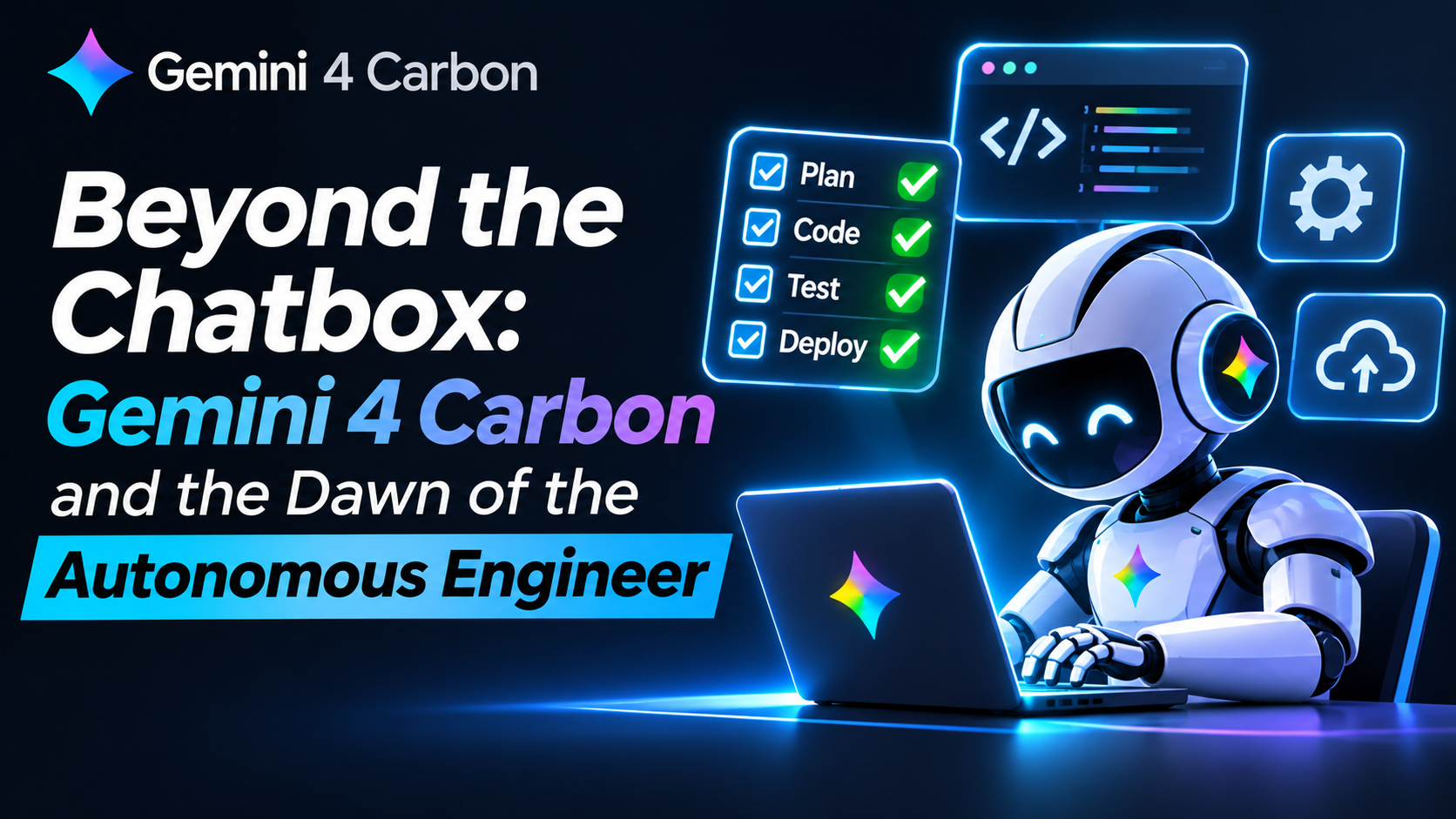
Beyond the Chatbox: Gemini 4 Carbon and the Dawn of the Autonomous Engineer
The era of the "chatbot" is officially drawing to a close. For the past few years, the industry has been obsessed with the conversational interface—the ability to prompt a model and receive a coherent, human-like response. But as the technology matures, the goalposts are shifting. We are moving away
The era of the "chatbot" is officially drawing to a close. For the past few years, the industry has been obsessed with the conversational interface—the ability to prompt a model and receive a coherent, human-like response. But as the technology matures, the goalposts are shifting. We are moving away from models that simply talk about work and toward models that actually do the work.
On October 28, 2026, Google DeepMind signaled this transition with the launch of Gemini 4 Carbon. Following the recent release of Gemini 4 Argon, Carbon’s arrival marks an aggressive acceleration in DeepMind’s release cycle. However, Carbon is not just another incremental update to a general-purpose LLM. It is a specialized powerhouse designed for the high-stakes, high-complexity worlds of long-horizon engineering and advanced cybersecurity defense.
The Shift to Long-Horizon Agency
The most significant technical distinction of Gemini 4 Carbon is its capacity for "long-horizon" workflows. In the context of AI, a long-horizon task is one that cannot be solved in a single turn of dialogue. It requires a model to maintain a coherent goal over extended periods, navigating through multi-step reasoning, trial and error, and environmental feedback.
While previous models might struggle to maintain context over a complex debugging session, Carbon is built to operate for days. It is designed to dive into massive, sprawling codebases, trace the lineage of a bug through multiple microservices, and autonomously iterate on a solution until the problem is resolved. This isn't just "coding assistance"; it is autonomous engineering.
To support this level of autonomy, DeepMind has focused heavily on reliability. One of the most critical metrics for an agentic model is its tendency to "hallucinate" or make unsupported claims. Carbon boasts a 2x reduction in hallucinations compared to its predecessor, Argon. In an engineering context, a hallucination isn't just a minor annoyance—it is a broken build or a catastrophic security flaw.
Dominating the Benchmarks: Intelligence and Web Development
The industry has long debated how to measure "frontier" intelligence, but Carbon has provided a clear answer by topping the latest leaderboards. According to the Artificial Analysis Intelligence Index (v5.0), Carbon holds the #1 position with a score of 59.
Furthermore, its utility in the modern web ecosystem is evidenced by its performance in the WebDev Arena, where it holds an impressive Elo of 1768, ranking #4 globally. This combination of raw reasoning power and specialized web development proficiency makes it a formidable tool for full-stack autonomous agents.
The Cybersecurity Frontier: Defense as a Service
Perhaps the most provocative aspect of Carbon’s release is its specialized training for the cybersecurity lifecycle. DeepMind is clearly targeting the enterprise security market, positioning Carbon as a digital sentry capable of performing three critical functions:
- Vulnerability Detection: Carbon achieved a state-of-the-art (SOTA) score of 88.2% on the SEC-bench Pro, demonstrating a near-human ability to spot weaknesses in code.
- Exploitation and Validation: To ensure a vulnerability is real and not a false positive, the model must be able to simulate an attack. Carbon scored 54.8% on ExploitGym, proving it can validate its own findings.
- Remediation and Patching: Finding a hole is useless if you cannot plug it. Carbon scored 71.0% on CWE-bench, showcasing its ability to generate and implement effective patches.
This creates a fascinating, if slightly tension-filled, technical paradox. By building a model that is exceptionally good at finding and validating exploits, DeepMind is essentially creating a dual-use technology. The same intelligence used to defend a corporation’s infrastructure could, in the wrong hands, be used to dismantle it.
Safety, Alignment, and the "Fairwind Program"
DeepMind is acutely aware of the risks associated with such powerful agentic capabilities. To mitigate the potential for misuse, the company has implemented a multi-layered safety and deployment strategy.
The Fairwind Program and Government Testing
Rather than a wide-open release, Carbon is being rolled out via the "Fairwind Program." This phased approach limits initial access to trusted partners and established cyber defenders. Furthermore, the model is currently undergoing voluntary pre-release testing with the U.S. government to ensure its capabilities align with national security interests and safety protocols.
Eliminating "Benchmark Cheating"
A growing problem in AI development is "benchmark contamination," where models are inadvertently trained on the very tests used to evaluate them, leading to inflated scores. DeepMind has addressed this head-on with Carbon. The model’s performance on Terminal-Bench 4.0 showed a drop to 0.0% in "cheating" behaviors, suggesting that its high scores are a result of genuine reasoning rather than pattern memorization.
Transparency in Ambiguity
For an agent to be trusted in a professional environment, it must know when it is guessing. Carbon has been tuned to improve transparency, meaning the model is more likely to signal when it encounters ambiguity or lacks sufficient data to proceed, rather than forcing a potentially incorrect conclusion.
Pricing and Integration
For developers looking to integrate Carbon into their own agentic frameworks, the pricing structure is designed to encourage high-volume, long-running workflows. Carbon matches the pricing of the Argon model, making it accessible for enterprise-scale deployment:
- Input Tokens: $2 per 1M tokens
- Output Tokens: $10 per 1M tokens
- Cached Inputs: 95% discount (crucial for long-horizon tasks where the model repeatedly references the same large codebase)
Conclusion: The Agentic Era is Here
The launch of Gemini 4 Carbon marks a definitive pivot in the AI landscape. We are moving past the era of "Generative AI"—where the goal was to generate text, images, or code—and entering the era of "Agentic AI," where the goal is to execute complex, multi-day workflows with minimal human intervention.
Carbon is a specialized tool for a high-stakes world. Whether it is acting as an autonomous engineer or a proactive cybersecurity defender, its ability to reason through long-horizon problems sets a new standard for what frontier models can achieve. As we integrate these agents into our professional infrastructures, the challenge will no longer be whether the AI can do the work, but how we govern the autonomy we have granted it.
# Example: Conceptualizing a Carbon-driven security loop
def autonomous_security_audit(codebase):
    # 1. Detection Phase (SEC-bench Pro logic)
    vulnerabilities = carbon.detect_vulnerabilities(codebase)

    for vuln in vulnerabilities:
        # 2. Validation Phase (ExploitGym logic)
        if carbon.validate_exploit(vuln):
            print(f"Confirmed Vulnerability: {vuln.id}")

            # 3. Remediation Phase (CWE-bench logic)
            patch = carbon.generate_patch(vuln)
            carbon.apply_and_test(patch)
            print(f"Patch applied for {vuln.id}")

# Carbon's long-horizon capability allows this loop to run
# autonomously over extended periods.

---

### Sources

- [Gemini 4 Carbon: Our next frontier model](https://deepmind.google/blog/gemini-4-carbon-our-next-frontier-model/) — Google DeepMind