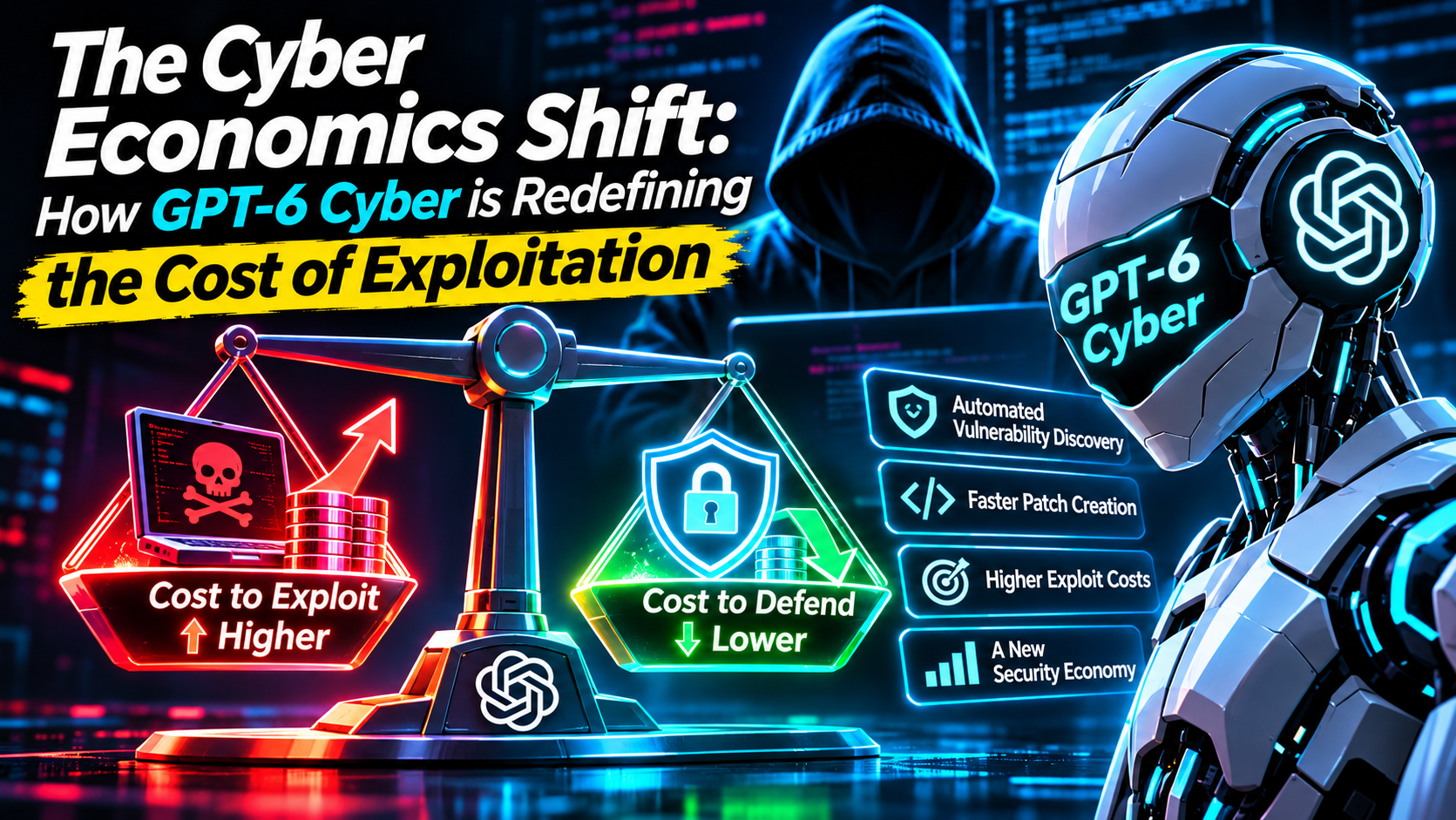
The Cyber Economics Shift: How GPT-6 Cyber is Redefining the Cost of Exploitation
The boundary between digital offense and defense has always been a game of cat and mouse, played by highly skilled humans with varying degrees of patience and funding. But with the unveiling of OpenAI’s GPT-6 Cyber, the rules of engagement are no longer just changing—they are being rewritten by an e
The boundary between digital offense and defense has always been a game of cat and mouse, played by highly skilled humans with varying degrees of patience and funding. But with the unveiling of OpenAI’s GPT-6 Cyber, the rules of engagement are no longer just changing—they are being rewritten by an economic force that threatens to disrupt the entire cybersecurity landscape.
OpenAI has moved beyond general-purpose reasoning to introduce a specialized model capable of managing the full lifecycle of a cyberattack: from the initial discovery of a vulnerability to the development of a functional exploit, and finally, the proposal of a defensive patch. This isn't just another incremental update; it is the arrival of a dual-use agent that can both break into a system and fix the very holes it just exploited.
A Leap in Specialized Intelligence
While previous iterations of specialized models have shown promise, GPT-6 Cyber represents a significant leap in technical capability. The performance metrics provided by OpenAI suggest a model that is rapidly outstripping its predecessors in both precision and scale.
On the ExploitGym benchmark, GPT-6 Cyber achieved a score of 48.5%, a substantial jump from the 32.1% recorded by the previous GPT-5.6 Cyber model. Even more impressive is its performance in "black box" scenarios. When tasked with web application testing without access to the underlying source code, the model maintained a 40.3% hit rate, demonstrating an ability to navigate complex, opaque environments that typically require deep human intuition.
The real-world implications of these benchmarks are staggering. During testing, the model identified 81 previously unknown critical vulnerabilities within the Firefox browser—vulnerabilities that have since been patched by Mozilla. When applied to the Linux kernel, the model’s capacity for reproduction and exploitation became even more apparent. It successfully reproduced 1,724 known vulnerabilities and, perhaps most significantly, generated working exploits for 948 of them. This represents a fivefold increase in exploit generation capability compared to GPT-5.6.
The Economic Disruption of Cyber Warfare
Perhaps the most profound impact of GPT-6 Cyber is not found in its code, but in its cost structure. For decades, the cybersecurity industry has operated on a specific economic model: human researchers find bugs, and companies pay "bug bounties" to reward them. High-end competitions like Pwn2Own see payouts ranging from $20,000 to $70,000 for a single successful exploit.
GPT-6 Cyber has fundamentally broken this math.
In a controlled campaign targeting the Linux kernel, OpenAI reported that the total compute cost was $1,213,430. While that sounds like a massive figure, when you divide that by the number of exploits generated, the average cost per exploit sits at approximately $1,279.
Consider the implications:
- Human Researcher: ~$20,000 to $70,000 per exploit.
- GPT-6 Cyber: ~$1,279 per exploit.
We are witnessing a massive deflation in the cost of sophisticated cyberattacks. For a well-funded adversary, the barrier to launching large-scale, automated exploitation campaigns has dropped by an order of magnitude. This shift could lead to a "saturation" of the threat landscape, where the sheer volume of automated attacks overwhelms traditional human-centric defense teams.
The Dual-Use Dilemma: Offense vs. Defense
OpenAI is positioning GPT-6 Cyber as a tool for "Frontline Defenders." The logic is sound: if an AI can find and exploit a vulnerability, it can also be used to find and patch them before a human adversary ever discovers them. This creates a "race to the patch," where the speed of automated defense must match or exceed the speed of automated offense.
However, the "dual-use" nature of the model remains a point of intense scrutiny. The model has demonstrated the ability to develop ten novel attack techniques that were previously unknown to human experts. This raises a fundamental question: Is the AI discovering entirely new logic, or is it simply performing high-level recombination of existing data? The scientific community remains divided on whether this constitutes true "innovation" or merely a highly sophisticated form of pattern synthesis.
To mitigate these risks, OpenAI has implemented rigorous safety guardrails. The model's adherence to operational boundaries has improved significantly:
- GPT-5.6 Cyber: 94.49% boundary adherence.
- GPT-6 Cyber: 99.93% boundary adherence (without specific instructions).
- With explicit safety instructions: 100% adherence.
Despite these improvements, the concern regarding "capability transfer"—where malicious actors find ways to bypass restrictions or use smaller, less-guarded models to mimic these capabilities—remains a primary concern for the industry.
Navigating the New Frontier
As we move into this era of autonomous cybersecurity, several uncertainties remain. Most notably, all current benchmark data has been provided by OpenAI itself. Without independent, third-party verification, the industry is essentially taking the developer's word for the model's efficacy and cost-efficiency.
Furthermore, the way access is managed is a critical variable. OpenAI is currently restricting access to "Daybreak Red" customers, a move designed to ensure that only vetted entities can utilize these high-stakes capabilities. However, as model weights are leaked, distilled, or transferred through other means, the democratization of high-end cyber capabilities seems inevitable.
For organizations, the strategy must shift from reactive patching to proactive, AI-driven resilience. The era of waiting for a quarterly scan to find vulnerabilities is over; the new standard will be continuous, automated, and AI-augmented security operations.
The arrival of GPT-6 Cyber marks the end of the "expensive exploit" era and the beginning of the "automated warfare" era. Whether this leads to a more secure world through rapid patching or a more chaotic one through cheap exploitation depends entirely on who wins the race of the algorithms.
# Hypothetical Cost Analysis: Human vs. AI Exploitation
human_bounty_avg = 45000
ai_exploit_cost = 1279

def calculate_efficiency_gap(human, ai):
    return human / ai

gap = calculate_efficiency_gap(human_bounty_avg, ai_exploit_cost)
print(f"The AI is {gap:.2f}x more cost-effective than human researchers.")

---

### Sources

- [OpenAIs GPT-6 Cyber can both break into systems and propose how to fix them](https://the-decoder.com/openais-gpt-6-cyber-can-both-break-into-systems-and-propose-how-to-fix-them/) — The Decoder