Stop Buying Better GPUs: The Bottleneck Reality of Ming-3.0-TTS
If you are building a local text-to-speech (TTS) pipeline and find that your high-end NVIDIA hardware is sitting idle while the audio generates at a snail's pace, you might be tempted to reach for your credit card. The logic seems sound: more VRAM or more CUDA cores should equate to faster synthesis
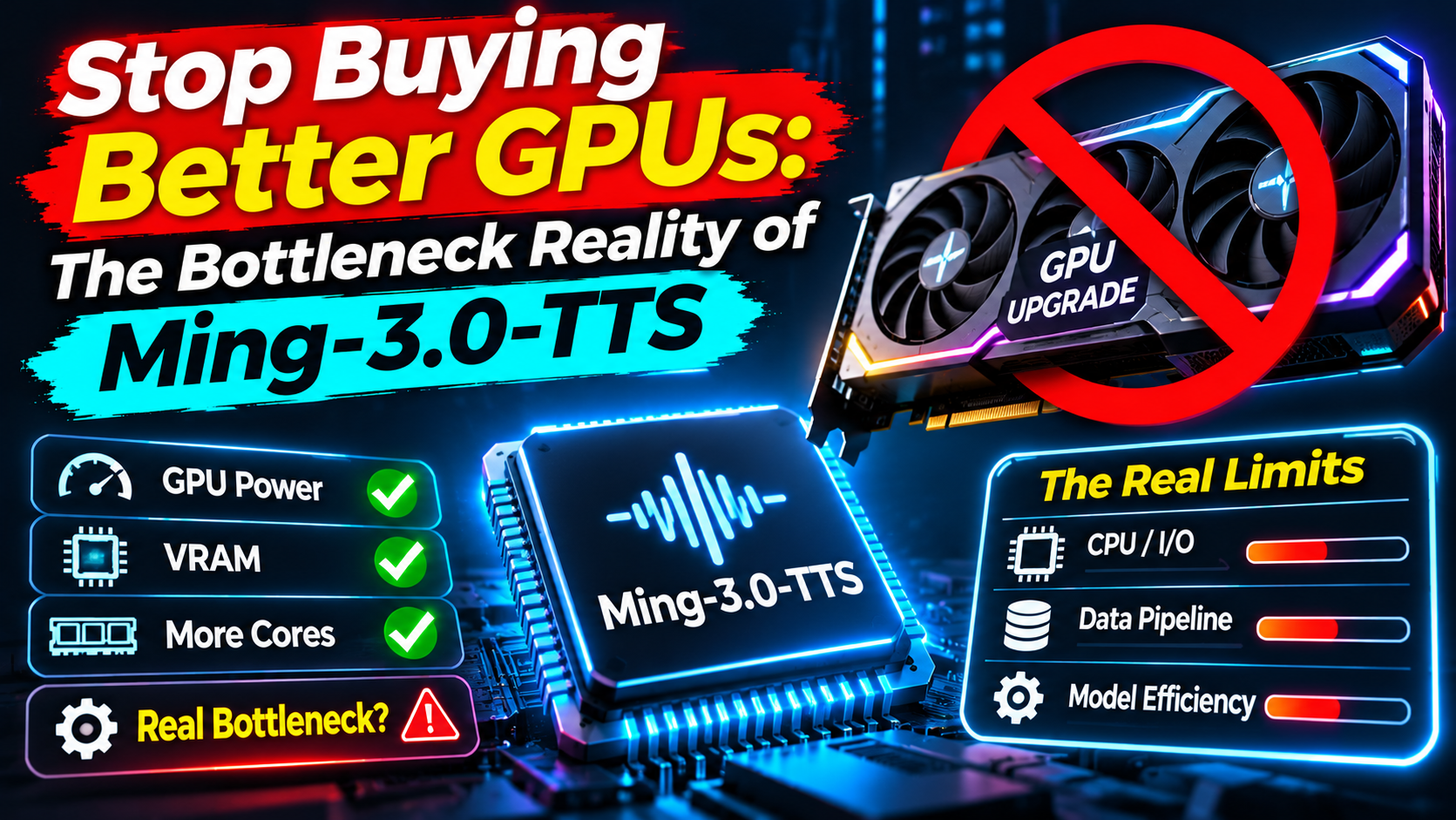
If you are building a local text-to-speech (TTS) pipeline and find that your high-end NVIDIA hardware is sitting idle while the audio generates at a snail's pace, you might be tempted to reach for your credit card. The logic seems sound: more VRAM or more CUDA cores should equate to faster synthesis. However, recent deep dives into Ming-3.0-TTS—the 0.5B parameter model from Ant Group’s inclusionAI team—reveal a frustrating reality for developers.
In many deployment scenarios, upgrading your GPU is essentially throwing money at a problem that doesn't exist. When running Ming-3.0-TTS, the primary constraint isn't the raw horsepower of your graphics card; it is a fundamental architectural bottleneck in how the model handles its decoding loop.
Understanding Ming-3.0-TTS
Before we dissect the hardware performance, it is important to understand what Ming-3.0-TTS brings to the table. Released under the MIT license, this model is a versatile tool for voice cloning and emotional expression. It allows users to provide short audio samples for cloning, use text-based voice prompting, and even inject emotional nuance using inline tags like [Laughter].
While the official documentation points toward high-end enterprise hardware like the H800 or H20 GPUs, real-world testing suggests that the model is much more accessible—albeit much more temperamental—than the documentation implies.
The "Decode Loop" Problem: Why Your GPU is Bored
The most striking finding in recent performance testing is the massive underutilization of GPU resources. When running the model on an RTX 2000 Ada (a 16 GB card), the GPU was found to be idle for more than two-thirds of the entire inference process.
This isn't a sign of a "light" model; it is a sign of a "starved" model. The issue lies in the decoding process. Ming-3.0-TTS builds audio step-by-step, with each step taking approximately 80ms. However, the Python code responsible for managing these steps—preparing the tensors, launching the next kernel, and handling the logic between iterations—is CPU-bound.
In simpler terms, the GPU is like a high-speed chef waiting for instructions. The chef can cook a meal in seconds, but the waiter (the CPU/Python backend) takes several seconds to deliver the next order. Because the "waiter" is too slow, the "chef" spends most of their time standing still.
The Diminishing Returns of Upgrading
This bottleneck becomes even more apparent when we look at the scaling benefits of more powerful hardware. When the model was moved from an RTX 2000 Ada to an RTX 4090, the performance gain was a mere ~17%.
In the world of AI, a 17% increase in speed for a massive jump in hardware cost is a terrible ROI. This marginal improvement occurs because the 4090 isn't actually helping the GPU work faster; rather, the system as a whole benefits slightly from the faster host processor and the reduced overhead of the higher-end architecture. The core issue—the Python-driven decode loop—remains the primary speed limiter.
VRAM and Memory Management
One of the biggest misconceptions in local AI deployment is that you need massive amounts of VRAM to run small-parameter models. Through a process of PyTorch memory capping, researchers have been able to estimate the actual footprint of Ming-3.0-TTS.
Despite the lack of official minimum requirements from the authors, testing shows that the model requires roughly 4 GB of VRAM to operate (including driver overhead). This is a critical takeaway for developers: you do not need a 24 GB or 48 GB card to run this model. A mid-range card with 6 GB to 8 GB of VRAM is more than sufficient for the model's weight requirements.
However, a word of caution: while we can estimate the 4 GB requirement via software capping on a 16 GB card, we do not yet have verified data on how the model behaves on actual 4 GB hardware. There is always a risk of instability when operating at the absolute edge of memory limits.
Performance Metrics: The Real-Time Factor
To understand the practical implications, we have to look at the Real-Time Factor (RTF). In TTS, an RTF of 1.0 means it takes one second to generate one second of audio. An RTF below 1.0 means the model is "faster than real-time."
On the RTX 2000 Ada, the performance was as follows:
- Input: A 20.7-second English paragraph.
- Output Processing Time: 31–32 seconds.
- Resulting RTF: ~0.65 (meaning it is actually slower than real-time).
Because the RTF is below 1.0, Ming-3.0-TTS is currently unsuitable for live, real-time voice agents or interactive conversational AI where low latency is mandatory. It is, however, a perfectly viable candidate for asynchronous tasks, such as generating recorded narration for videos or podcasts.
Current Limitations and Technical Caveats
While Ming-3.0-TTS is a powerful tool, it is not without its flaws. Developers should be aware of several technical hurdles before integrating it into production environments.
1. Text Normalization Issues
The model's ability to interpret text is inconsistent. While English normalization works for standard prose, it struggles significantly with numbers. For example, a phone number might be misinterpreted as a series of subtraction operations. Even more critical is the lack of support for Spanish; current Spanish text normalization produces nonsensical outputs for numerical values.
2. Evaluation Uncertainties
There are two major "black boxes" in the current research:
- Concurrency: All testing has been conducted using a single-request backend. We do not know how the model handles multiple simultaneous requests or if the CPU bottleneck worsens under load.
- Speaker Recognition: The model reports speaker-recognition scores between 0.84 and 0.87. However, there is a suspicion that these scores are inflated because the model is being evaluated using the same recognition logic it was trained with.
Summary of Hardware Strategy
If you are planning a deployment, use this checklist to avoid overspending:
| If your goal is... | Do NOT... | DO... | | :--- | :--- | :--- | | Lowering VRAM costs | Buy an A100/H100 | Aim for 8GB+ VRAM cards | | Increasing generation speed | Buy a faster GPU | Look into optimizing the Python decode loop or upgrading the CPU | | Real-time interaction | Rely on Ming-3.0-TTS | Look for models with optimized C++ or Rust backends | | Batch narration | Worry about latency | Use existing mid-range hardware |
Conclusion
The lesson of Ming-3.0-TTS is a vital one for the modern AI engineer: nvidia-smi can be a lying metric. If you see low GPU utilization, the solution isn't more silicon; it's better software orchestration. Until the decoding loop is moved out of the slow Python interpreter and into a more efficient execution environment, the most expensive GPU in the world will still spend most of its time waiting for instructions.
# Pro-tip: If monitoring your inference, watch the CPU usage
# alongside the GPU. If CPU spikes while GPU stays low,
# you've found your bottleneck.

---

### Sources

- [Ming-3.0-tts on a 16 GB card: the GPU sat mostly idle, and why a bigger one barely helps](https://dev.to/inferencekey/ming-30-tts-on-a-16-gb-card-the-gpu-sat-mostly-idle-and-why-a-bigger-one-barely-helps-4bo0) — DEV Community · AI