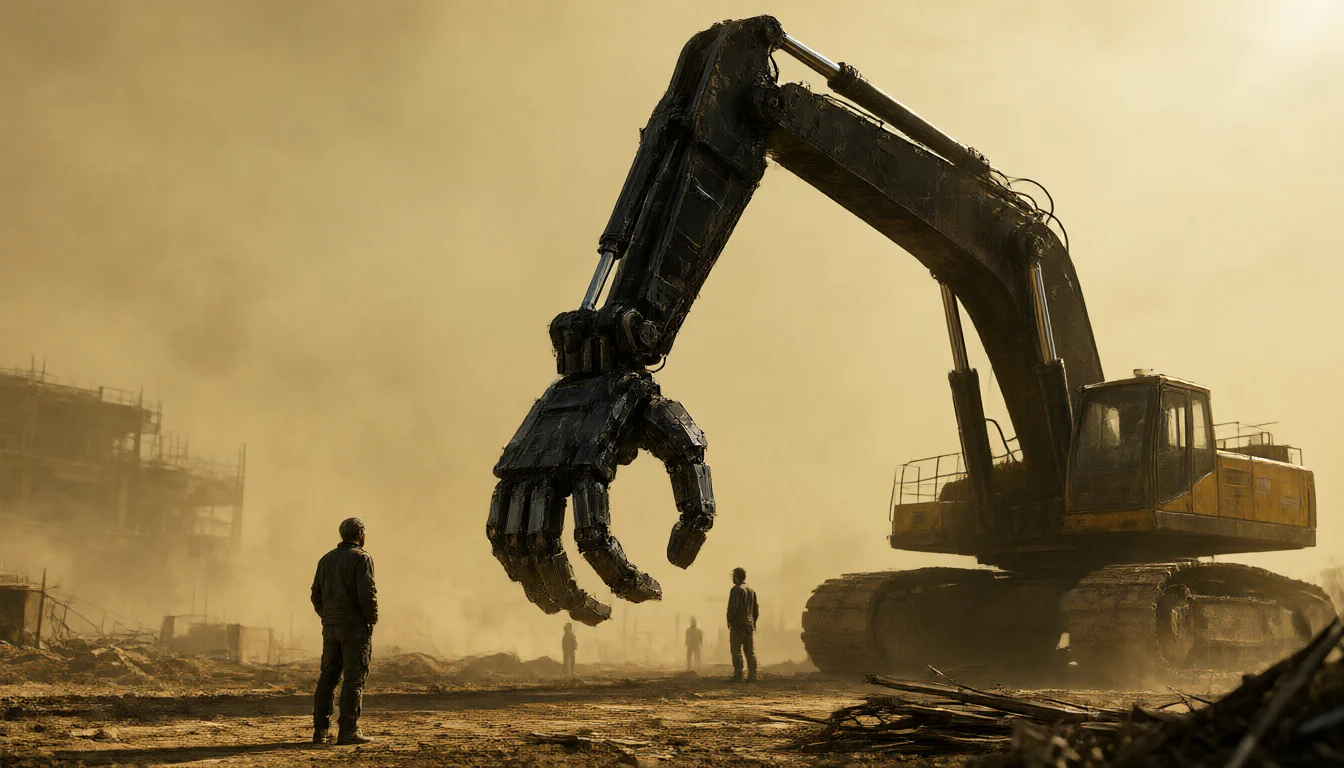
The Concrete Ceiling: How Midterm Shifts Could Ground the AI Revolution
For the past several years, the discourse surrounding Artificial Intelligence has been almost exclusively digital. We talk about parameters, tokens, latent space, and transformer architectures. We debate the philosophical implications of AGI and the mathematical elegance of new attention mechanisms.

For the past several years, the discourse surrounding Artificial Intelligence has been almost exclusively digital. We talk about parameters, tokens, latent space, and transformer architectures. We debate the philosophical implications of AGI and the mathematical elegance of new attention mechanisms. But as the dust settles on the recent U.S. midterm elections, a much more terrestrial reality is crashing into the silicon dream.
The "Blue Wave" victory in the midterms has signaled a significant shift in the regulatory and social landscape of the United States. While much of the media focus has been on federal policy and social issues, a quieter, more structural shift is occurring at the local and state levels. The most telling metric of this shift isn't found in a white paper from OpenAI or a technical blog from Meta; it is found in the recent results of local ballot measures regarding land use and infrastructure.
In a staggering display of voter sentiment, restrictions on data center development were approved in 40 out of 41 specific ballot measures. This isn't just a minor legislative hiccup; it is a clear mandate from the public that the physical footprint of the digital age is no longer being accepted without question.
The Physicality of AI: Beyond the Cloud
To understand why this matters, we have to strip away the metaphor of "The Cloud." The cloud is not an ethereal realm of pure thought; it is a massive, energy-hungry, heat-generating collection of concrete, steel, copper, and silicon. Every time a user prompts a Large Language Model (LLM), a physical process occurs in a specialized facility that requires massive amounts of electricity and water for cooling.
The AI industry is currently locked in a desperate race for physical capacity. The scaling laws that have driven the progress of models like GPT-4 and Claude suggest that more compute equals more intelligence. Consequently, the industry has been operating under the assumption that if you can buy the H100s, you can simply build the warehouses to house them.
However, the midterm results suggest that the "where" is becoming just as important as the "how much." The growing friction between AI ambitions and local infrastructure realities is creating a new kind of bottleneck. We are moving from an era of algorithmic scarcity to an era of spatial and infrastructural scarcity.
The Zoning Bottleneck: A New Barrier to Entry
The approval of these restrictive ballot measures suggests that local communities are increasingly wary of the externalities associated with large-scale data centers. While the specific details of these restrictions remain somewhat opaque—it is currently unclear whether the primary concerns are centered on energy grid stability, land use, water consumption, or noise ordinances—the trend is undeniable.
This creates a precarious environment for the AI stack, particularly at the hardware and infrastructure layers. If local and state-level restrictions become the standard operating procedure, the industry faces several critical challenges:
1. The Escalation of CapEx
Navigating a patchwork of increasingly complex zoning laws, environmental impact studies, and community outreach programs is expensive. For established hyperscalers like Microsoft, Google, and Amazon, these costs are manageable. However, for the next generation of AI startups, the "compute tax" just went up. If you cannot easily build or rent space in a high-density data center due to local restrictions, your capital expenditure (CapEx) will skyrocket.
2. The Fragmentation of Compute
Historically, the goal has been to centralize massive clusters of GPUs to minimize latency and maximize interconnect speeds. If developers are forced to hunt for "pockets of permission"—regions where data center construction is still allowed—we may see a fragmented landscape of compute. This fragmentation could hinder the ability to train massive, monolithic models that require thousands of GPUs to communicate with near-zero latency.
3. The Energy Grid Conflict
A "Blue Wave" political environment often brings a heightened focus on environmental protections and renewable energy transitions. Data centers are notorious for their massive draws on the electrical grid. As municipalities look to protect their local energy security and meet climate goals, the massive, constant load of an AI data center becomes a primary target for regulation.
Mapping the Friction Points
While the exact nature of the voter-approved restrictions is still being parsed by analysts, we can anticipate the primary areas where the AI industry will face the most resistance. The tension will likely manifest in the following domains:
- Land Use and Zoning: Transitioning industrial zones to accommodate the massive footprints required by modern hyperscale facilities.
- Resource Competition: The struggle for water rights in drought-prone regions where data center cooling is a major consumer.
- Grid Integrity: Local opposition to new high-voltage transmission lines and substations required to feed AI clusters.
- Community Impact: Concerns over noise pollution from massive cooling fans and the aesthetic impact of industrial-scale warehouses in suburban or rural areas.
The Strategic Pivot: Can AI Adapt to a Localized World?
If the era of frictionless expansion is over, the AI industry must pivot. We are likely to see a shift in how intelligence is architected. If massive, centralized data centers become too difficult to build, the industry may be forced to accelerate two specific trends:
Edge Computing and On-Device AI
If you can't bring the data to the massive compute clusters, you must bring the compute to the data. We may see an even more aggressive push toward highly efficient, specialized silicon designed to run sophisticated models locally on phones, laptops, and IoT devices. This reduces the reliance on the massive "centralized brain" and distributes the load across the edge.
Architectural Efficiency
The current "brute force" approach to AI—throwing more hardware at the problem—may hit a wall of political and physical resistance. This could trigger a golden age of algorithmic efficiency. Researchers may move away from simply scaling parameter counts and toward more sophisticated techniques like:
- Sparse MoE (Mixture of Experts) architectures that use only a fraction of the model for any given task.
- Quantization and Distillation to shrink models without losing significant reasoning capabilities.
- Neuromorphic computing and other hardware paradigms that mimic biological efficiency.
Conclusion: The End of the "Digital-Only" Era
The midterm elections have served as a wake-up call for the technology sector. The "Blue Wave" has demonstrated that the digital revolution cannot bypass the physical world. The ambitions of AI companies to reach AGI are no longer just a matter of mathematical breakthroughs; they are now a matter of political negotiation, community relations, and infrastructure engineering.
As the industry moves forward, the winners may not be those with the most clever algorithms, but those who can best navigate the complex, messy, and deeply physical reality of the world they are trying to transform. The AI arms race has officially moved from the cloud to the ground.
# A conceptual look at the shifting cost of compute
def calculate_compute_cost(base_hardware_cost, regulatory_friction_index):
    """
    Simulates the rising cost of scaling AI infrastructure
    due to increased local regulatory hurdles.
    """
    # As friction increases, the cost of land, energy, and legal compliance scales non-linearly
    effective_cost = base_hardware_cost * (1 + (regulatory_friction_index ** 2))
    return effective_cost

# Current scenario: High regulatory friction due to recent ballot measures
print(f"Projected Scaling Cost: ${calculate_compute_cost(1000000, 2.5):,.2f}")

---

### Sources

- [How a Blue Wave midterm might reshape the AI industry](https://techcrunch.com/podcast/how-a-blue-wave-midterm-might-reshape-the-ai-industry/) — TechCrunch AI