


Reflection Is About to Drop the Open-Weight Bomb That Could Break China’s AI Stranglehold
On October 4, 2026, an Axios report landed with almost too much ease: Nvidia-backed startup Reflection is preparing to release its first open-weight model, and people close to the effort say it could be imminent. In a landscape where the most capable open models are almost uniformly Chinese, that isn’t merely a product launch. It’s a flag planted in the sand, and it’s going to be watched like a heavyweight title fight.
Reflection isn’t a startup that blends into the wallpaper. It was founded in March 2024 by two ex-Google DeepMind researchers, Misha Laskin and Ioannis Antonoglou, from a New York base that has quietly ballooned into one of the most well-funded AI labs on the planet. Now, with a model reportedly about to cross the finish line, the whole industry is asking the same question: what happens when America finally decides to fight China on open-weight turf — and actually brings the hardware to win?
The Scoop That Quietly Reshuffled the Board
Let’s be straight about why this news hit like a splash. For the last couple of years, the open-weight game has essentially been China’s country club. Models like DeepSeek, Qwen, Llama’s fiercest rivals, and a roster of others have shipped with weights fully exposed, letting anyone from a solo hacker to a national government run, fine-tune, and redistribute them. The West, meanwhile, has largely played the walled-garden game: OpenAI, Anthropic, and Google lock their best models behind APIs, paywalls, and terms of service that read like a hostage negotiation.
So when Axios reported that Reflection — a well-capitalized, Nvidia-sanctioned lab — is about to open its doors, the subtext was deafening. The US has been losing the open-weight argument by default, simply because it had nothing world-class to offer open developers. A strong American open model, running on Nvidia silicon, would hand developers a credible alternative to paying OpenAI, Anthropic, or Google whatever the tollmaster asks this month.
It also reframes the whole competitive narrative. This is no longer “will the US ship an open model?” It’s “how fast, and how good?” That shift from speculation to timeline is what makes this feel different from the usual launch-cycle rumor mill.
Who Is Reflection, Anyway?
If the name is new to you, you’re not alone — and that’s partly by design. Reflection was founded in March 2024 by Misha Laskin, who now runs the company as CEO, and Ioannis Antonoglou, both of whom came out of Google DeepMind’s inner circle. Laskin, in particular, arrived with real street cred in the research community from his work on reinforcement learning and world models, the kind of background that makes people assume a lab will move fast and think differently.
The lab is based in New York, a deliberate choice that keeps it a world away from the Bay Culture incubator, and it has spent its short life raising money like it expects a drought. Reflection has reportedly pulled in $2 billion or more since launch, with some reports pushing the figure well beyond $4 billion once later rounds are counted. At the center of all that capital is a valuation hovering around $25 billion, which places Reflection firmly in the “too big to ignore” club alongside the established giants.
What stands out isn’t just the size of the checks — it’s who’s writing them. The investor roster reads like a who’s-who of Silicon Valley power and Washington proximity: Sequoia Capital, Lightspeed Venture Partners, and DST Global are all in, along with former Google CEO Eric Schmidt, whose Good Ventures arm has long been a bellwether for serious AI bets. Then there’s Nvidia, which dumped $800 million into the company and, arguably more importantly, handed Reflection priority access to chips at a time when silicon is still the scarcest resource in the industry.
The Compute War Chest
Here’s the part that makes competitors sweat. Building a frontier model in 2026 isn’t about having a clever idea; it’s about controlling the cluster. And Reflection’s compute story is, frankly, staggering.
The company has reportedly locked up more than $7 billion in compute capacity through 2029, and the deals behind that number are the kind that most labs can only dream about:
- A Nebius deal worth more than $1 billion, giving Reflection a steady stream of advanced Nvidia hardware and the engineering backbone to run it.
- A SpaceX deal worth up to $6.3 billion, per reporting from July 2026, under which Reflection will pay roughly $150 million a month to run its Nvidia GB300 GPUs inside SpaceX’s Colossus 2 facility through 2029.
Let that last one sit for a moment. One hundred and fifty million dollars a month. That’s not a compute budget; that’s a small nation’s GDP on GPUs. The SpaceX arrangement is especially striking because it ties Reflection to Elon Musk’s space empire at a moment when the two most disruptive forces in tech — rocketry and frontier AI — are effectively sharing a power grid. Colossus 2 is already famous as one of the largest single AI training sites on Earth, and now it’s also the planned home of one of the most ambitious open-weight labs in history.
The strategic read here is simple: Reflection isn’t trying to out-think the competition on a lean cluster. It’s trying to out-compute them, at scale, on hardware it can actually rely on. In an industry where everyone complains about not having enough chips, Reflection has essentially bought the whole factory.
Openness as a Belief, Not a Gimmick
Reflection has a philosophy, and it’s worth taking seriously rather than dismissing as marketing. Laskin has framed the whole endeavor in almost philosophical terms, most memorably with the line: “Models are fundamental knowledge infrastructure, and fundamental knowledge infrastructure yearns for openness.”
Read that again. Laskin isn’t arguing that open weights are a nice product feature or a community-good afterthought. He’s arguing that foundational models are, in his framing, infrastructure on the same order as electricity grids or the early internet — things that shouldn’t be gated behind a private company’s login screen. The “yearns for openness” phrasing suggests that openness is the natural, almost gravitational state of good models, and that withholding them is a violation of their nature.
That’s a compelling story, and it’s a smart one, because it lets Reflection claim the moral high ground in a way pure commercial OpenAI-style players can’t. It also happens to be strategically brilliant. Open weights are the one area where the US has been on the wrong side of the world, letting Chinese labs define what “open” means. If Reflection can pair that ethos with genuinely frontier-class performance, it gets to fight the China question on the exact battlefield where China has been winning.
But it’s worth raising the honest tension here. A lab this deeply entangled with the Pentagon, the Department of Energy, and a foreign-allies export program isn’t exactly an anarchist collective smashing the paywalls. There’s a real question of whether “openness” survives contact with a national-security mandate — or whether Reflection is quietly building the template for a new kind of openness, one that’s open to allies and vetted partners but firmly gated where it matters. That tension is going to define Reflection’s story for years, and it’s one the company hasn’t fully answered yet. The irony, of course, is that Reflection is using some of the most closed, tightly-gated relationships in tech — Pentagon contracts, Department of Energy access, allied-government exports — to promote an openly-delivered product.
The China Question — Openness, Allies, and the Pentagon
This is the part that makes the whole thing matter beyond any single product launch. Right now, the hierarchy of powerful open-weight models reads like a map of China’s AI ambitions. When developers worldwide want a strong model they can run freely, cheaply, and without handing over their data to a US cloud provider, the default answer has increasingly been a Chinese model. That’s a genuine strategic liability, because whoever controls the most widely deployed open models controls a lot more than market share — it controls standards, fine-tuning ecosystems, and the default assumptions baked into millions of downstream applications.
So when America finally decides to fight on open-weight turf, it isn’t just about one company. It’s about breaking a monopoly of expectation. Reflection sits right at the center of that fight, and the politics are baked into the very structure of the company. Alongside Sequoia, Lightspeed, and DST Global, the investor list includes 1789 Capital — the firm where Donald Trump Jr. is a partner — and Eric Schmidt, the ex-Google chief turned influential AI-government dealmaker. That mix of old-money VC, political access, and establishment wisdom is a recipe for a lab that can move fast in public and move even faster in private. The government ties are just as pronounced: Reflection’s partnerships with the Pentagon and the US Department of Energy place it inside the most sensitive corners of the security apparatus, while its work developing models for allies like South Korea ties it directly to the administration’s industrial and foreign policy. The Trump administration has made countering Chinese AI dominance an explicit priority, and this is a national asset it has deliberately chosen to back.
Think about what that means in practice. South Korea, Japan, European firms — anyone wary of leaning on either a US walled garden or a Chinese open model now has a third path: an American open-weight model running on Nvidia chips, carrying the semantics and safety expectations that come with Washington’s orbit. In a world where AI is becoming the bedrock of both military and economic power, “which model do we build on” is one of the most consequential questions a country can face. Reflection is essentially offering to be the answer.
It’s a double-edged sword, though, and anyone watching should hold both edges at once. On one side, it explains the staggering compute deals and the priority chip access: the establishment is pouring resources into Reflection because it sees the China problem as existential. On the other, a lab this integrated with national security is going to face hard questions about what “open” actually means when the same entity builds models for the Pentagon and exports them to allied governments. Openness and control don’t always get along, and Reflection will have to navigate that minefield in public.
What It Means — And The Fight Is Just Starting
Strip away the funding rounds and the geopolitical framing, and the bottom line for ordinary developers, founders, and curious users is pretty exciting. If Reflection ships a genuinely strong open-weight model, it does something the entire industry has been waiting for: it puts a world-class, freely usable model on the table that runs on ubiquitous Nvidia hardware and doesn’t require signing away your soul to a US cloud giant. That single development could quietly rewire a huge chunk of the AI ecosystem:
- Costs could drop fast. When a credible open alternative exists, the closed-API incumbents lose their pricing power. Cheaper inference, cheaper fine-tuning, and cheaper research all follow.
- Innovation could decentralize. Developers who’ve been locked out of frontier capabilities by paywalls can finally experiment, build, and compete on a level-ish playing field.
- Sovereignty becomes real. Countries and companies that don’t want to lean entirely on China or on a single US provider get an actual third option for the infrastructure their futures will run on.
There’s also a practical wrinkle worth naming. Open weights are a double-edged sword even for the people who champion them: the same transparency that lets a startup fine-tune a model over a weekend is what makes open systems harder to monitor and regulate than the walled-garden frontier labs. Axios itself flagged that these models can slip past the oversight frameworks that the “Big Three” operate under, which is exactly why governments on both sides of the Pacific are so interested — and so nervous. Reflection is walking a line between “here’s a free, powerful tool for everyone” and “please don’t use this to build the thing we don’t want built,” and how it resolves that question will set the template for the whole open-weight industry going forward.
At the same time, nobody should pretend this is purely a gift to the open-source faithful. Reflection is a for-profit company with a $25 billion valuation, deep political ties, and a national-security mandate. Its openness will almost certainly come with boundaries, partnerships, and strategic limits. The real story isn’t “openness wins” — it’s that the US is finally deciding to fight the open-weight war, and it’s bringing more money, more chips, and more conviction than anyone expected.
Reflection’s open-weight model hasn’t even shipped yet, and it’s already reshaping the board. With a $25 billion valuation, billions locked up in compute through 2029, Nvidia chips in hand, and the full weight of the US national-security establishment behind it, this is a lab built to win a specific kind of war — the one against Chinese dominance in open AI. Whether that mission produces genuine, borderless openness or a carefully gated version of it is the question that will define Reflection’s legacy. One thing’s for sure: when this model finally drops, it’s going to be one of the most watched moments in AI this year. So tell us — is an American open-weight model paired with Nvidia chips the checkmate China has been waiting for, or is all this money and political backing just another overbuilt tower in a game where openness was never really about freedom?
—
Image Prompt
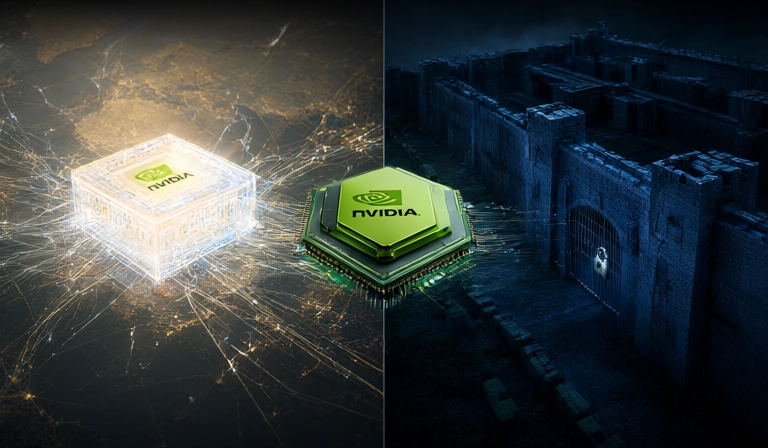
Subject: A split-screen geopolitical AI battle image — one side a glowing, open, translucent AI model chip radiating light and connection lines to a global network; the other side a dark, walled-garden fortress with locked gates. A large Nvidia-green chip bridges the two.
Style: Cinematic tech-editorial, photorealistic, deep contrast between warm open light and cold blue fortress tones, high detail, dramatic lighting.
Composition: Center — a luminous open AI processor (Nvidia-green accents) emitting open network threads toward a world map, with a gated dark fortress receding in the background.
Mood: Strategic, intense, high-stakes.
Negative prompt: blurry, low detail, watermark, text artifacts, cluttered, distorted chip.