


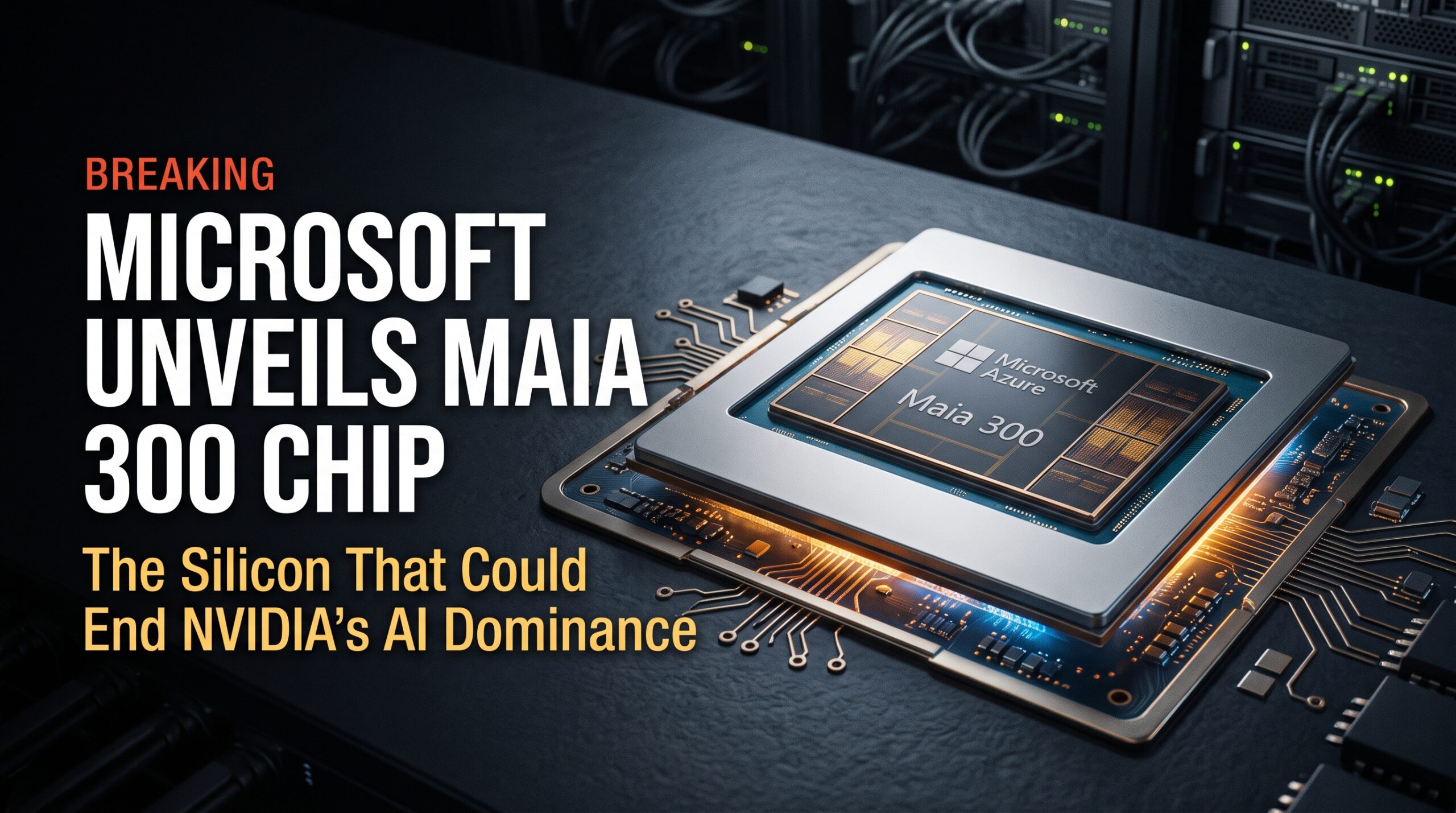
BREAKING: Microsoft Unveils Maia 300 Chip — The Silicon That Could End NVIDIA’s AI Dominance
REDMOND, Wash. — In a move that industry analysts are already calling “the biggest bet yet on our own silicon,” Microsoft today unveiled Maia 300, its latest custom AI accelerator chip, announcing plans to deploy the technology at scale beginning in 2027. The announcement marks a pivotal moment in the trillion-dollar AI race as major tech giants increasingly turn away from NVIDIA’s dominance to build proprietary hardware solutions that promise lower costs, improved performance, and greater control over their AI infrastructure.
According to Microsoft, the Maia 300 will deliver 40% more AI tokens per megawatt than leading GPU-based systems, a quantum leap in energy efficiency that comes at a time when power consumption is becoming the single biggest constraint on AI deployment. The chip is specifically engineered to minimize unnecessary data movement between chips and memory — addressing what Microsoft executives have described as “a growing bottleneck as AI models become more complex.”
But this isn’t just another incremental improvement. This represents something far more profound: Microsoft’s declaration that it no longer needs to wait for NVIDIA to lead the charge. As Azure chief Scott Guthrie stated in a blog post following the announcement, Maia will become “the primary AI inference system for Microsoft products and services” — effectively ending Microsoft’s decades-long reliance on NVIDIA’s CUDA ecosystem for its own workloads.
Microsoft CEO Satya Nadella amplified the significance of the move in a post on X (formerly Twitter), calling it “our biggest bet yet on our own silicon.” The timing couldn’t be more consequential: with AI inference costs eating up an increasing percentage of tech companies’ operating budgets, and NVIDIA’s pricing power seemingly unchecked, Microsoft’s decision to develop competitive alternatives has triggered immediate reactions across the entire semiconductor industry.
The End of an Era? How Every Major AI Player Is Now Building Chips
What makes today’s announcement particularly significant is that it’s not an isolated incident. It represents a broader pattern that has been quietly developing throughout 2026 — nearly every major AI player is now developing or deploying their own custom silicon, seeking to break free from NVIDIA’s stranglehold on the market.
### Google: The Long Game Pays Off
Google has been developing its own Tensor Processing Units (TPUs) for years, with its latest generation including separate versions optimized specifically for training AI models and running inference workloads. Unlike Microsoft’s aggressive timeline, Google has taken a more gradual approach, integrating TPUs incrementally across its cloud infrastructure while maintaining strong NVIDIA partnerships for certain workloads.
### OpenAI: The Jalapeño Advantage
OpenAI’s strategy with Broadcom has been equally ambitious. The company is developing its Jalapeño chip, initially focusing on inference workloads before expanding to training capabilities. In August 2026, OpenAI publicly announced that its first Jalapeño chip was “outperforming NVIDIA hardware on certain workloads” — a claim that sent shockwaves through the industry and prompted immediate scrutiny from NVIDIA’s investor relations team.
### Amazon: Trainium Takes Center Stage
Amazon has been quietly deploying its Trainium family of AI chips across its AWS infrastructure, with customers including major players like Anthropic already committing to use Amazon’s custom silicon as part of massive infrastructure agreements. The success of Trainium has reportedly led to renewed investment in Amazon’s chip development program, with plans for a next-generation iteration expected later this year.
### Anthropic: Going It Alone?
In August 2026, Anthropic confirmed it was exploring its own chip designs, even as the company continued to rely on chips from NVIDIA, Amazon, and other suppliers. While Anthropic’s in-house silicon ambitions remain less advanced than those of its larger competitors, the mere announcement has sent signals that the market is ripe for competition.
### Meta: The Chip That Never Was?
Meta also maintains an internal chip development program while continuing to buy substantial computing capacity from NVIDIA and other suppliers. Unlike some of its competitors, Meta hasn’t publicly announced specific product roadmaps, leaving analysts to speculate about whether the company will ever commit to deploying custom silicon at scale or if it will remain a customer-first strategy.
What Makes Maia 300 Different? The Technical Breakdown
For those who care about the actual engineering behind the hype, Microsoft’s announcement includes several key technical specifications that distinguish Maia 300 from its competitors and NVIDIA’s current offerings:
### Energy Efficiency as the Primary Metric
The 40% improvement in AI tokens per megawatt is not merely a marketing claim — it represents years of focused R&D on power management and memory architecture. In an era where data centers are consuming unprecedented amounts of electricity, this metric matters more than raw compute power for many workloads. Microsoft’s approach prioritizes inference efficiency over brute-force performance, recognizing that most AI deployments spend the vast majority of their time running inference rather than training new models.
### Memory Architecture Innovation
The chip’s design specifically targets “unnecessary data movement between chips and memory” — a bottleneck that has plagued AI infrastructure as models have grown from hundreds of billions to trillions of parameters. By integrating memory controllers directly into the compute units and employing novel caching strategies, Maia 300 reduces the latency penalties associated with fetching data from off-chip memory pools.
### Software Compatibility Strategy
Perhaps the most contentious aspect of Microsoft’s announcement is its approach to software compatibility. While NVIDIA has built an overwhelming moat through CUDA — a decades-long ecosystem that developers worldwide have come to depend upon — Microsoft appears determined not to repeat that mistake. Azure chief Scott Guthrie emphasized during the presentation that Maia will be “designed from the ground up for inference workloads,” suggesting that Microsoft may sacrifice some training capabilities to gain efficiency advantages in the area where margins are highest.
### The Hybrid Approach
“We want a broad ecosystem while investing deeply in our first-party silicon,” said Rani Borkar, Microsoft’s president of Azure Hardware Systems and Innovation. This statement has been interpreted by industry analysts as a signal that Microsoft may not immediately abandon NVIDIA entirely, but rather adopt a hybrid strategy where certain workloads run on Maia 300 while others continue to leverage CUDA infrastructure.
The Economics: Why Custom Silicon Makes Financial Sense
Behind the technical specifications lies a compelling economic argument that has driven every major AI company’s decision to pursue custom chips. The economics of AI inference are brutal — with cloud providers charging $10-50 per million tokens depending on the model and deployment configuration, even high-volume customers can see their infrastructure costs spiral out of control without optimization.
### The Margin Game
Inference workloads typically offer much higher margins than training because they require less specialized hardware and can be deployed at scale across existing infrastructure. By developing Maia 300 specifically for inference, Microsoft is positioning itself to capture both the revenue from running AI services and the cost savings from avoiding third-party pricing.
### The Supply Chain Reality
Even as companies develop their own chips, they remain dependent on the same limited manufacturing capacity, advanced packaging, and high-bandwidth memory that NVIDIA relies upon. This means that custom chip development doesn’t necessarily eliminate broader supply chain constraints — it simply shifts the leverage point from purchasing decisions to design and integration capabilities.
### The Scale Problem
Microsoft’s announcement included a sobering timeline: “Maia 300 deployments will begin in 2027, but reaching multi-gigawatt scale will take time, extending beyond next year.” This admission highlights the reality that even the world’s largest technology company cannot simply flip a switch and deploy custom silicon overnight. The semiconductor manufacturing ecosystem has significant bottlenecks that require years of planning and investment to overcome.
What This Means for Developers, Businesses, and Consumers
The implications of Microsoft’s Maia 300 announcement extend far beyond the tech industry. Here’s what different stakeholders should expect in the coming months and years:
### For AI Developers
1. Platform Fragmentation: As more companies deploy custom silicon, developers will need to write code that can run across multiple hardware backends. This could mean abandoning CUDA entirely or developing abstraction layers that mask hardware differences — both of which come with significant development overhead.
2. Skill Gap Expansion: Engineers who understand the nuances of different chip architectures will become increasingly valuable. The days of writing generic PyTorch code that runs anywhere are coming to an end as hardware-specific optimizations become necessary for competitive performance.
3. Vendor Lock-in Risks: While Microsoft claims Maia will be compatible with existing software stacks, the reality is that proprietary hardware often requires custom tooling and support. Companies that invest heavily in a particular vendor’s infrastructure risk becoming locked into that ecosystem.
### For Businesses Using AI Services
1. Pricing Pressure: As Microsoft and other competitors deploy custom silicon at scale, we should expect to see reduced pricing for AI services as competition heats up. The current market is characterized by NVIDIA’s pricing power, but this dynamic could shift dramatically once alternatives reach maturity.
2. Service Reliability: Custom silicon deployments introduce new failure modes and maintenance requirements. Businesses relying on cloud providers’ AI services may experience different reliability profiles depending on the underlying hardware architecture.
3. Integration Complexity: Migrating workloads between different hardware backends will require careful planning and potentially significant retraining costs. Organizations that have built their infrastructure around CUDA may find themselves in a difficult position as alternatives emerge.
### For Consumers
1. Faster Innovation Cycles: Competition in AI hardware should accelerate the pace of innovation, bringing new capabilities to consumers more quickly than we’ve seen in recent years. The current market is dominated by NVIDIA’s conservative approach to product releases.
2. Lower Costs for AI-Powered Services: As competition intensifies, prices for AI-powered applications — from customer service chatbots to creative tools — should decrease as providers pass on their infrastructure cost savings.
3. Privacy and Data Considerations: Custom silicon deployments may offer new opportunities for data localization and privacy protection, as companies gain more control over their infrastructure decisions.
The NVIDIA Factor: Can the Chip King Survive This Challenge?
NVIDIA’s reaction to Microsoft’s announcement has been measured but firm. In a statement released shortly after the unveiling, NVIDIA emphasized its continued commitment to innovation and its leadership position in AI computing. However, industry analysts have noted that NVIDIA’s revenue more than doubled to $96 billion in the second quarter of 2026, a reminder that overall demand for AI computing remains robust despite competition.
### The Training vs. Inference Divide
The market is clearly splitting along functional lines: NVIDIA remains dominant for training workloads, where its ecosystem and software stack have created an insurmountable moat. Meanwhile, competitors are focusing on inference — where margins are highest and where custom silicon can offer meaningful advantages through optimization.
### The Ecosystem Moat
What makes NVIDIA’s position so strong is not just the hardware itself, but the decades of development invested in CUDA, the programming model that has become synonymous with GPU computing. Microsoft’s announcement suggests it may not attempt to compete directly on this front, instead focusing on inference-specific optimizations that don’t require full CUDA compatibility.
### The Supply Chain Reality
Even as companies develop their own chips, they remain dependent on the same manufacturing ecosystem — TSMC for advanced nodes, SK Hynix and Samsung for HBM memory, and specialized packaging vendors. This means that custom chip development doesn’t necessarily reduce dependence on NVIDIA’s supply chain partners; it simply shifts the leverage point from purchasing decisions to design capabilities.
The Timeline: What to Expect in 2027 and Beyond
Microsoft has provided a clear roadmap for Maia 300 deployment, though industry analysts warn that the timeline may prove optimistic given the complexities involved:
Q1-Q2 2027: Initial pilot deployments across select Microsoft services and Azure customers. This phase will focus on validating performance claims and identifying any software compatibility issues.
H2 2027: Expansion to broader Azure infrastructure, with initial capacity reaching approximately 50% of Microsoft’s current inference workloads.
2028-2029: Full-scale deployment across all Microsoft products and services, potentially displacing NVIDIA hardware for the majority of inference workloads.
Beyond 2030: Expectation of Maia 400 or later generations, with continued improvements in efficiency and capabilities.
Industry Reactions: What Competitors Are Saying
The announcement has triggered immediate responses across the industry:
### NVIDIA’s Response
NVIDIA executives have downplayed the threat, emphasizing that their revenue growth demonstrates sustained demand for their products. However, the company has also begun its own initiatives to support customer custom chip development through partnerships and consulting services — a strategy designed to maintain relationships even as customers build alternatives.
### Amazon’s Stance
AWS CEO Adam Selipsky emphasized during a recent conference that Trainium represents “just one option” for AWS customers, with the company maintaining strong NVIDIA partnerships while continuing to invest in custom silicon development.
### Google’s Position
Google has remained largely silent on the announcement, though industry observers note that the company’s long-term TPU strategy suggests it sees custom silicon as a competitive advantage rather than a cost center.
### Microsoft’s Messaging
Microsoft has been deliberate in its messaging, emphasizing that Maia 300 will serve “Microsoft’s own products and services” rather than Azure customers. This distinction is important because it means OpenAI and other third-party providers on Azure may not immediately benefit from the efficiency gains.
The Bigger Picture: What This Says About AI Infrastructure Strategy
Beyond the immediate implications for chip vendors and cloud providers, Microsoft’s announcement signals a fundamental shift in how technology companies approach AI infrastructure:
### From Renting to Owning
The era of simply renting compute power is ending. Major tech companies are realizing that the economics of AI demand ownership of the underlying infrastructure. This trend will likely accelerate as competition intensifies and pricing pressure mounts.
### The Rise of Vertical Integration
Microsoft’s move represents a broader trend toward vertical integration across the technology industry. Companies that control their entire stack — from chip design to software deployment — are better positioned to optimize for their specific workloads and maintain competitive advantages.
### Supply Chain Sovereignty
The announcement also signals growing concern about supply chain dependencies. By developing custom silicon, companies reduce their vulnerability to supplier pricing changes and capacity constraints — though they don’t necessarily eliminate dependence on the broader semiconductor manufacturing ecosystem.
What’s Next? The Road Ahead for AI Hardware Competition
As Microsoft announces Maia 300, we’re entering a new phase of AI hardware competition that will reshape the industry for years to come. Here are the key developments to watch:
### Short-Term (6-12 Months)
- Continued announcements from other major tech companies about their own chip initiatives
- Increased investment in semiconductor manufacturing capacity across the industry
- Software ecosystem adaptations as developers adjust to new hardware options
### Medium-Term (1-3 Years)
- First-generation Maia 300 deployments reaching scale
- Emergence of competing inference-focused silicon from other vendors
- Potential consolidation in the custom chip market as smaller players struggle with manufacturing constraints
### Long-Term (3-5 Years)
- Mature multi-vendor AI hardware ecosystem
- Standardization efforts to ensure software compatibility across different chip architectures
- New generation of AI-specific processors with capabilities we cannot yet imagine
The Bottom Line
Microsoft’s unveiling of Maia 300 today marks a watershed moment in the AI industry. For years, NVIDIA has reigned supreme as the undisputed king of AI computing, but that monopoly is finally cracking under the weight of determined competition from its biggest customers.
The technical specifications — particularly the 40% improvement in AI tokens per megawatt and the focus on minimizing data movement — suggest that Microsoft’s engineers have cracked some fundamental challenges around efficiency that will benefit the entire industry. The broader implications — for pricing, for developer workflows, for supply chain dynamics — are equally significant.
As we move into 2027 and beyond, expect to see an AI infrastructure landscape that is more diverse, more competitive, and potentially more affordable than the current NVIDIA-dominated model. Whether this leads to better outcomes for developers, businesses, and consumers remains to be seen, but one thing is clear: the era of single-vendor dominance in AI computing is coming to an end.
What This Means
### For Developers
The fragmentation of AI hardware backends will require new skill sets and tooling approaches. Expect to see increased investment in abstraction layers and cross-platform development frameworks that can handle multiple chip architectures seamlessly. Companies that build their expertise around CUDA alone may find themselves needing rapid adaptation strategies.
### For Businesses
AI infrastructure costs should begin declining as competition intensifies, but migration costs could be significant for organizations heavily invested in NVIDIA ecosystems. The key strategic decision will be whether to maintain multi-vendor flexibility or commit deeply to a particular hardware path.
### For Consumers
The ultimate beneficiaries of this competition should see more affordable and accessible AI-powered services. As infrastructure costs decline and innovation accelerates, the gap between enterprise-grade AI capabilities and consumer applications should narrow considerably.
Spicyskynet Analysis: This announcement fundamentally alters the competitive landscape for AI infrastructure. While NVIDIA remains dominant in training workloads, the inference market — where most revenue is generated — is about to become a multi-vendor battleground. The efficiency gains Microsoft claims could be transformative if validated, potentially reshaping pricing models across the entire industry within 12-18 months.
Keywords: Microsoft Maia 300, NVIDIA competition, custom AI silicon, inference optimization, chip design revolution, AI infrastructure shift, enterprise AI economics, data center efficiency, tech hardware strategy, semiconductor innovation